
The Indian rupee experienced a significant surge against the US dollar following the Reserve Bank of India's measures to restrict banks from onshore forward markets. Despite this, the rupee remains under pressure from foreign capital outflows, a strong dollar, and rising crude oil prices.

"There is a sharp jump that we have seen in bookings of EVs... The jump, at least in our case, in just two months, it is about 2 to 2.5 times of what it used to be"

Maruti Suzuki has discontinued its Ignis hatchback due to weak sales and a shift towards SUVs, while simultaneously facing supply chain issues for its popular S-Presso and WagonR models, leading to booking halts at some dealerships.

India's economy experienced a growth of 7.8 per cent during the October-December quarter of 2025-26, according to the new series of national accounts with 2022-23 as the base year.

Indian equity benchmarks Sensex and Nifty surged nearly 1 per cent, driven by strong earnings reports from FMCG and auto sectors, alongside a rally in Asian markets and signs of de-escalation in geopolitical tensions.

Simplifying GST rates, removing exemptions, easing disputes, and speeding up refunds can boost investment in India and offer the best reply to Trump's tariffs, observes V S Krishnan, former member, Central Board of Indirect Taxes and Customs.

India's net revenues from the Goods and Services Tax (GST) rose at a three-month high pace of 10.7 per cent in August even as growth in gross collections slowed to 6.5 per cent from 7.5 per cent in the previous month, thanks to a nearly 20 per cent decline in refunds to taxpayers during the month.

Bajaj Auto is set to launch new Pulsar motorcycles in the 125cc and 150-250cc segments in Q2 FY27, aiming to capitalise on the upcoming festival season surge. This move follows strong growth in the 150cc-plus segment, where refreshed Pulsar models already account for over 50 per cent of Bajaj's sales.

As lower GST rates take effect on Monday, sales of air-conditioners, TV sets surged dramatically with buyers rushing to grab cheaper deals offered by retailers at the beginning of the Navratra festival.
Among Sensex firms, Tata Motors rose the most by 3.5 per cent while Adani Ports gained 3.16 per cent. Reliance Industries rose by 2.82 per cent. Eternal, Tech Mahindra, Kotak Mahindra Bank, Hindustan Unilever and Maruti were also among the gainers. However, Bajaj Finserv, Power Grid, Mahindra & Mahindra and HCL Tech were among the laggards.

Fexo, an AI intelligence platform focused on the BFSI sector, has launched its AI decisioning engine for business loans, designed to help financial institutions accelerate AI adoption and improve decision-making processes.

Noting that recent uncertainties created by global tariffs have not impacted the Indian economy severely, Anuradha Thakur, secretary, Department of Economic Affairs, said the central government is hopeful that the recent goods and services tax (GST) rationalisation will ignite the much needed animal spirits in the financial sector.

Congress leader Rahul Gandhi criticised Prime Minister Narendra Modi and West Bengal Chief Minister Mamata Banerjee, accusing them of prioritising the wealthy over the poor and failing to create job opportunities.
The Indian rupee rebounded against the US dollar following intervention by the Reserve Bank of India, amidst ongoing concerns about foreign capital outflows, rising crude oil prices, and geopolitical instability.

India's electric passenger vehicle market saw an 87.4 per cent year-on-year increase in FY26, reaching 233,246 units, primarily driven by the mid-size SUV segment (20-30 lakh price bracket), while the entry-level segment (sub-10 lakh) experienced a decline.

GST 2.0 may cushion consumers against US tariffs, but like the 2019 corporate tax cut, it risks being another tactical fix rather than a structural growth strategy, expects Debashis Basu.

Traders in Karnataka are raising concerns over GST demand notices based on UPI transaction data. A tax official defends the action, stating it's within the law and recipients can respond with documentation.

Among Sensex firms, Maruti zoomed the most by 8.94 per cent. Bajaj Finance rallied over 5 per cent, UltraTech Cement by 3.71 per cent, and Bajaj Finserv by 3.7 per cent. Mahindra & Mahindra, Hindustan Unilever and Trent were also among the gainers. However, ITC was the biggest loser, dropping by 1.26 per cent. Eternal, Tech Mahindra and Larsen & Toubro also declined.

Among Sensex firms, Mahindra & Mahindra, Tata Motors, Trent, Eternal, Asian Paints and Infosys were the major gainers. However, Sun Pharma, ITC, Hindustan Unilever and Titan were among the laggards.

India's electric vehicle (EV) market experienced a significant surge in financial year 2025-26 (FY26), with e4W registrations nearly doubling and e2Ws growing by over 20%, propelled by expanding charging infrastructure, diverse model launches, and accessible financing.

If TVK MLAs and ministers are perceived as clean, or demonstrably cleaner than their predecessors, the credibility dividend will be enormous. The voter will feel rewarded, points out Ramesh Menon.

'The government is putting insurance in the same category as food, which is essential for life.' 'Now this is an opportunity for the sector to focus on the consumer.'

Data from used-car platforms suggest that buyer preferences have remained broadly stable post-GST, with SUVs retaining their dominance even as price adjustments played out across segments.

'At the first sign of real trouble, that money will move. There will be a run.'
At the D Y Patil International University's Foundation Day, experts advised students to embrace AI wisely, highlighting its potential and the importance of critical thinking in the digital age.

India's two-wheeler industry is seen growing 6-9% in 2026, though a proposed ABS mandate for sub-125cc models could push up prices and temper volumes.

Gross GST collections increased by 6.2 per cent to over Rs 1.84 lakh crore in June but slipped below the Rs 2 lakh crore mark recorded in the previous two months. Gross GST collections stood at Rs 173,813 crore a year ago, as per government data released on Tuesday.

To meet liquidity pressure because of advance tax outflows this month, the Reserve Bank of India (RBI) has adopted a measured approach with its latest announcement of open-market operations (OMOs), worth Rs 1 trillion.
Gross GST collections remained above the Rs 2 trillion mark for the second month in a row, rising 16.4 per cent in May to over Rs 2.01 lakh crore. Goods and Services Tax (GST) collection had touched a record high of Rs 2.37 lakh crore in April. In May, 2024, the mop up was Rs 1,72,739 crore.

The eight-month intensive programme is designed to help professionals develop comprehensive expertise across both data science and decision science, said IIT-Delhi.

TransUnion Cibil CEO Bhavesh Jain highlights the improved retail portfolio quality in January but stresses the need for lenders to continuously engage with borrowers on credit usage and repayment, similar to the approach taken during the Covid-19 pandemic, as the impact of the Iran war on credit quality is still being assessed.
Gross GST collections rose by 9.1 per cent to about Rs 1.84 lakh crore in February, boosted by domestic consumption and indicating potential economic revival. As per the official data released on Saturday, on a gross basis, mop up from Central GST stood at Rs 35,204 crore, State GST at Rs 43,704 crore, Integrated GST at Rs 90,870 crore and compensation cess of Rs 13,868 crore.

Opposition leaders have criticised Prime Minister Narendra Modi's address to the nation, calling it politically motivated and a misuse of official platforms during ongoing elections.

Retail inflation slipped to a multi-year low of 0.25 per cent in October, driven by the impact of the GST rate cut and subdued prices of vegetables and fruits, government data showed on Wednesday.

Recent developments - proposed changes to the goods and services tax (GST) rates and S&P Global Ratings' upgrade of India's long-term sovereign credit rating to BBB, with a stable outlook, - may not be enough to bring foreign investors back to Indian markets in a rush, feel analysts.
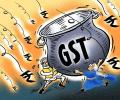
Goods and Services Tax (GST) collection rose 12.6 per cent Y-o-Y to an all-time high of about Rs 2.37 lakh crore in April, which the government said shows resilience of the Indian economy and the effectiveness of cooperative federalism. The gross GST mop-up was Rs 2.10 lakh crore in April 2024 -- the second highest collection ever since GST was rolled out on July 1, 2017. The net mop-up was Rs 1.92 lakh crore.

A host of macroeconomic data announcements, global trends and trading activity of foreign investors would dictate investors' sentiment in the stock market this week, analysts said. Besides, auto sales data will be closely tracked, experts noted.

In an event-heavy week ahead, stock markets' movement would highly depend on macroeconomic data announcements, global trends, RBI's interest rate decision and trading activity of foreign investors, analysts said. India's industrial production data for October 2025 will be released on December 1, an official statement said on Friday.

In October, small car wholesales of the auto industry -- excluding Tata Motors -- went up by 8.4 per cent Y-o-Y to 116,601 units, the data showed. However, the utility vehicle (UV) segment which includes sports utility vehicles (SUVs) as well as multi-purpose vehicles (MPVs), saw a bigger growth in October.

Investors and startup executives are calling for extending the period for an entity to be recognised as a startup from 10 to 15 years for deep-tech companies.
